




- Bitcoin’s rally cooled after the FOMC, with long-term holders realizing 3.4M BTC in profits, marking the largest distribution phase of this cycle.
- ETF inflows that balanced selling pressure earlier in the cycle slowed to near zero, leaving distribution dominant and weakening short-term market stability.
- Spot selling, futures deleveraging, and options repricing confirmed exhaustion, making the $111K short-term holder cost basis the crucial level sustaining market strength.
Bitcoin rally cools after the FOMC surge, with long-term holders realizing 3.4M BTC in profits. ETF inflows slowed, leaving $111K as the critical short-term holder cost basis to prevent deeper cooling in the market.
Momentum Fades After the FOMC Rally
Bitcoin’s rally peaked near $117k during the FOMC event before entering correction. The move reflected a “buy the rumour, sell the news” pattern.
The drawdown remains modest at 8% from the $124k all-time high. By comparison, earlier cycles recorded far steeper declines of up to 60%. This underlines the trend of reduced volatility within more mature phases.
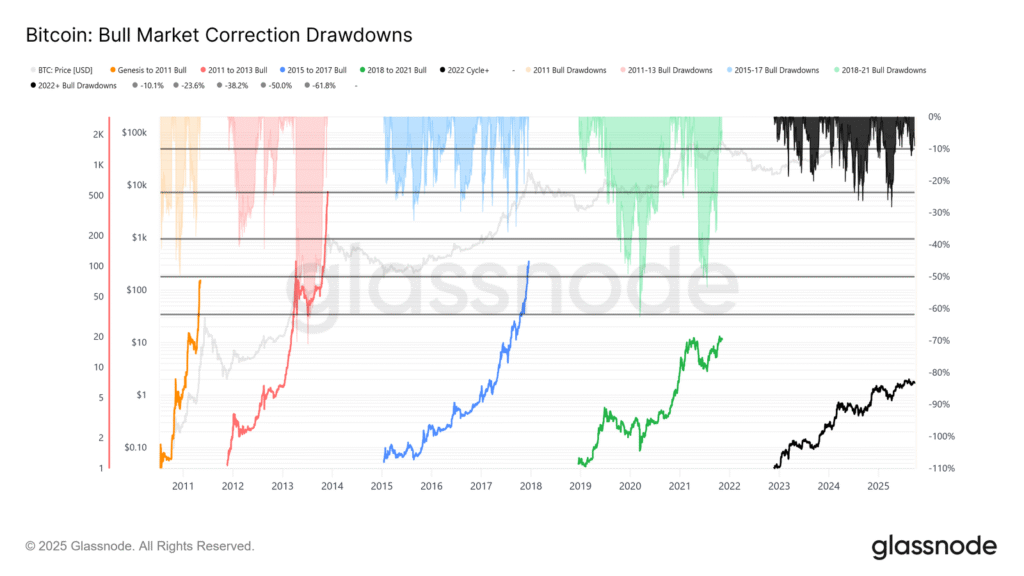
Despite the retreat, Bitcoin remains above longer-term supports. The cooling reflects fatigue rather than collapse, as traders gauge whether stability or extended correction follows.
Cycle Duration and Historical Patterns
The Bitcoin cycle is about 1,030 days old, which is nearly identical to the two past Bitcoin cycles, which were around 1,060 days.. This uniformity underscores a cyclical pattern of Bitcoin.
Returns have diminished across cycles. The present phase continues this pattern, showing smaller peak gains but maintaining steady long-term growth. The maturing structure remains evident across historical comparisons.
If the $124k level proves to be the top, the cycle’s duration matches earlier phases almost precisely. The main difference lies in the scale of capital flowing through this market.
Realized Cap and Capital Deployment
Realized Cap, which reflects deployed capital, rose to $1.06 trillion, supported by $678 billion in inflows since November 2022. This shows the scale of investment supporting the cycle.
These inflows are 1.8x larger than those seen in 2018–2022, which totaled $383 billion. The pace marks this cycle as one of the most intense in terms of capital rotation.
Compared with earlier eras — $4.2 billion from 2011–2015 and $85 billion from 2015–2018 — the magnitude of today’s flows reflects Bitcoin’s growth into a global macro asset.
Long-Term Holders Realize Heavy Profits
Long-term holders have distributed 3.4M BTC, already surpassing the realized profits of previous cycles. This confirms their role as key suppliers during this stage.
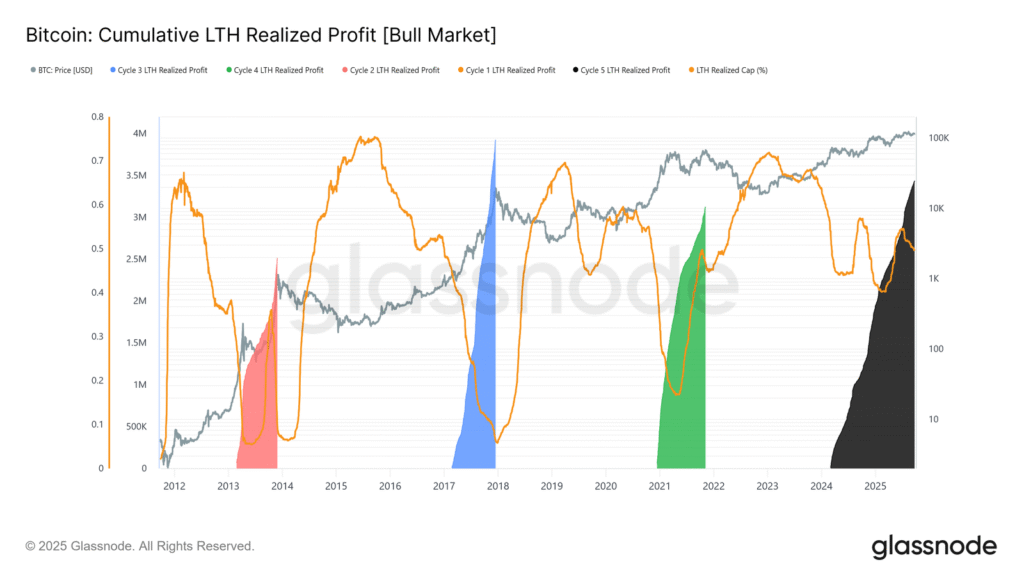
Distribution by long-term holders typically coincides with mature phases, where seasoned investors capture gains into strength. Their selling creates resistance, capping short-term upside while shifting supply into broader demand.
On-chain data shows three distinct surges in profit-taking this cycle, each above 90% of moved coins. The latest surge aligned with the post-FOMC cooling now underway.
ETFs Slow as Spot and Futures Weaken
ETF inflows balanced long-term holder selling earlier in the cycle, but this balance broke around the FOMC. Net flows collapsed from 2.6k BTC per day to nearly zero.
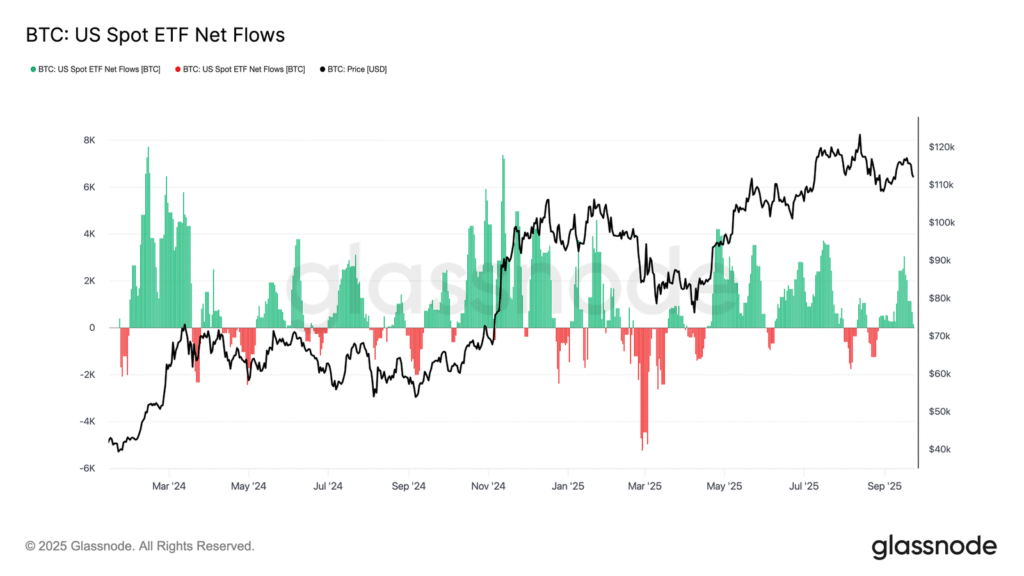
At the same time, distribution surged to 122k BTC per month.This kind of imbalance exposed the market to vulnerability with demand not able to absorb the growing supply.
Spot volumes rose as high as it became during the sell-off and open interest in futures fell to 43.7 billion. The liquidation of leveraged longs between $114k–$112k intensified the decline but cleared excess leverage
Options Repricing and the $111K Pivot
Options traders adjusted quickly to the turbulent week. Implied volatility rose into the FOMC, eased briefly, then surged again after Sunday’s liquidation event.
Skew spiked as demand for downside protection grew, with one-week skew rising from ~1.5% to 17%. Traders positioned defensively, while puts dominated volumes.
With options open interest near record highs, the $111k short-term holder cost basis has become pivotal. Holding above this level could stabilize conditions, but a break risks deeper cooling.
Bitcoin Market Outlook
Bitcoin’s rally cooled after the FOMC as long-term holder distribution, slowing ETF demand, and leveraged liquidations converged. The retreat marks a phase of fatigue rather than collapse.
Realized profits, heavy spot selling, and futures deleveraging confirmed the fragility of current conditions. Options markets added to the defensive stance, with skew tilted toward downside coverage.
The $111k cost basis now serves as the line to defend. If it holds, consolidation may steady the market. If lost, deeper correction risks will increase.
