




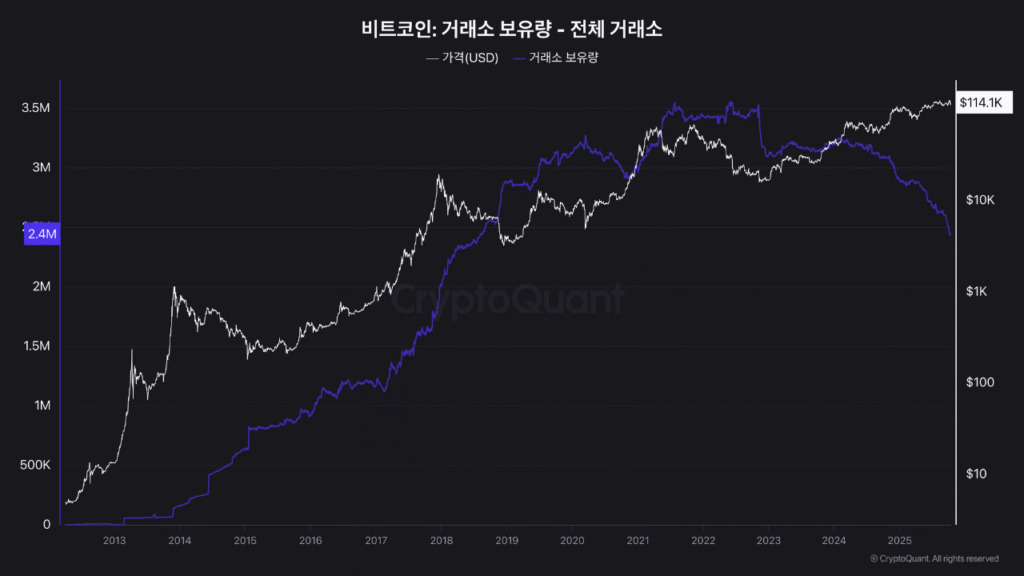
- The amount of Bitcoin held on exchanges fell to 2.4 million BTC due to ongoing outflows from exchanges, resulting in lower immediate selling pressure in the market.
- With institutional adoption and ETF custody increasing, long-term storage has accelerated, causing Bitcoin to leave exchanges and methodically move into stored wallets.
- In the past, decreasing reserves from exchanges have frequently marked the signal of bullish momentum. This suggests increased accumulation and also structural support below the prevailing market prices.
Bitcoin exchange balances are nearing historical levels not witnessed in over a decade, indicating a tighter supply environment. The on-chain metrics demonstrate consistent accumulation by long-term investors and institutions regardless of the price in the vicinity of $114,000.
Exchange Reserves Shrink
Bitcoin held on centralized exchanges has fallen to approximately 2.4 million BTC, down from more than 3.5 million in 2020. This continuous outflow represents one of the longest trends in Bitcoin’s history, reducing immediate sell pressure.
Many of the withdrawn coins move into cold wallets or institutional custody. On-chain tracking suggests deliberate storage choices rather than short-term trading activity. Exchange outflows highlight a growing preference for long-term holding among market participants.
Historical trends show that major BTC price increases often follow similar periods of declining exchange reserves. Previous cycles in 2020 and 2021 saw a steady reduction in exchange holdings before strong market expansions occurred.
Historical Supply Patterns
Between 2013 and 2018, exchange reserves increased sharply as liquidity grew with centralized platform adoption. More coins on exchanges allowed frequent trading and contributed to market depth.
Since 2020, reserves have steadily decreased alongside rising institutional adoption. ETFs, regulated custodial platforms, and cold storage solutions have driven these outflows. Individual long-term holders also increasingly prefer secure storage away from exchanges.
Periods of declining reserves have historically preceded bullish momentum. The current trend suggests accumulation is continuing, with structural support forming beneath the market despite short-term price consolidation.
Institutional Accumulation and Market Impact
Shrinking exchange reserves indicate a reduced pool of immediately tradable Bitcoin. This supply tightening occurs as institutions and long-term holders move assets into custody or offline storage.
The growth of regulated platforms and Bitcoin ETFs amplifies this trend. Coins leaving exchanges are often held for extended periods, reinforcing the scarcity of liquid supply available for trading.
On-chain data confirms these movements are consistent and systematic. Transfers to cold wallets and institutional custody reflect deliberate accumulation strategies rather than reactive market behavior. This pattern mirrors setups seen before previous significant market expansions.
The near-decade lows of Bitcoin’s exchange reserves indicate a supply-side contraction is in motion. Cognitive dissonance suggests that even if prices fluctuate in due time, the underlying structure demonstrates continued accumulation. Observing the long-term investor behavior as well as institutional activity gives us confidence that the market is trying to prepare for momentum in the future.
