




- Ethereum fund holdings have surged 138% year-over-year, positioning ETH as a primary institutional asset driven by ETF inflows and staking growth.
- Bitcoin’s fund holdings increased 36%, reflecting its continued role as a macro reserve while showing slower institutional expansion than Ethereum.
- The ETH/BTC holdings ratio rose from three-to-one to five-to-one, showing institutional capital’s growing preference for Ethereum’s yield-based infrastructure.
A new report from Cryptoquant analyst, XWIN Research Japan indicates that institutional investors are subtly reshaping the balance between Ethereum and Bitcoin. The shift reflects how capital allocation trends are quietly repricing the two leading digital assets in a changing macro and technological environment.
Ethereum Emerges as the New Institutional Benchmark
Ethereum’s role within institutional portfolios is evolving rapidly. Over the past year, total Ethereum fund holdings rose to about 6.8 million ETH, marking an increase of roughly 138%. This surge has been driven by inflows into spot Ethereum exchange-traded funds, expanding staking participation, and the network’s central function in decentralized finance and tokenization systems.
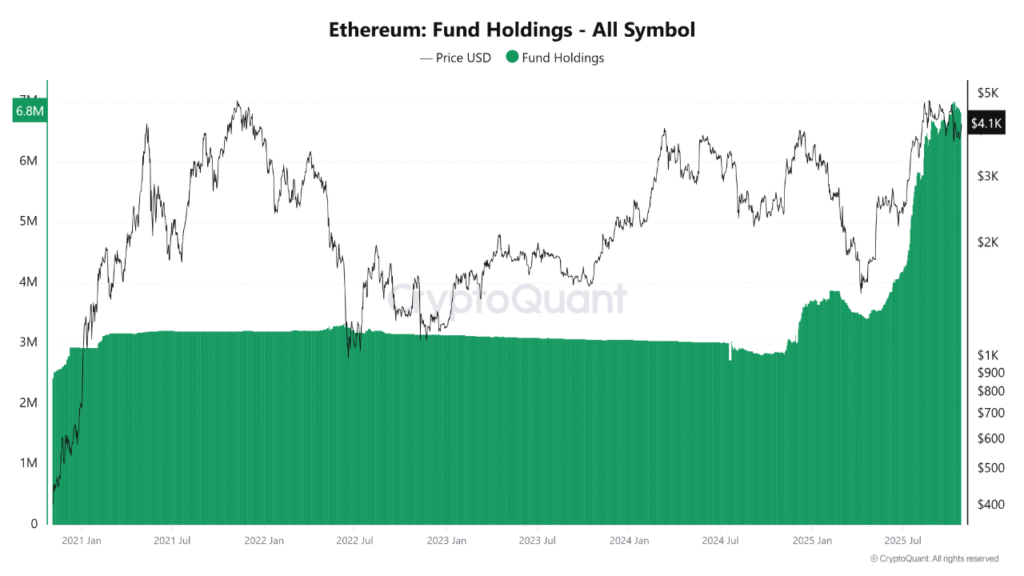
Source: CryptoQuant
Institutional investors are increasingly treating Ethereum not as an alternative exposure but as a foundational asset. Its yield-generating model through staking and its status as a settlement layer for digital applications are positioning ETH as a key component of long-term strategies. The rise in holdings signals that capital allocators are repricing Ethereum’s value proposition, viewing it as both infrastructure and income-producing technology within the digital economy.
Bitcoin’s Role Shifts Toward Capital Preservation
Bitcoin remains the largest institutional holding by market value, with about 1.3 million BTC under management—a 36% annual rise. Yet, its growth trajectory has stabilized. Institutional participation now centers on maintaining Bitcoin as a macro reserve rather than expanding positions aggressively.
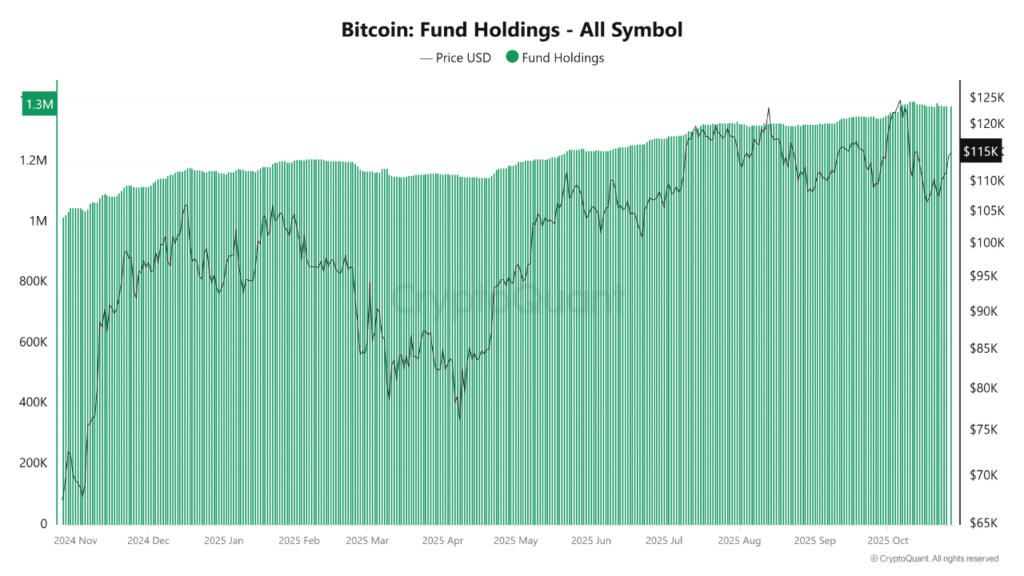
Source: Cryptoquant
This slower growth reflects Bitcoin’s maturity as a store of value. Institutional capital continues to recognize its hedge-like properties, but the inflow pattern shows that Bitcoin’s narrative has settled. Capital managers appear to be redefining Bitcoin’s role as a defensive allocation, focusing on preservation over expansion in an increasingly diversified crypto landscape.
Capital Flows Redefine the ETH-BTC Power Balance
The ETH/BTC fund holdings ratio has expanded from three-to-one to nearly five-to-one in the past year, according to XWIN Research Japan. This quiet shift underscores how institutional capital is repricing leadership within crypto, moving beyond volatility-driven cycles toward structural portfolio realignment.

Source: cryptoquant
Ethereum’s accelerating growth signals a market where infrastructure value is gaining preference over static monetary exposure. As institutional products dig in and on-chain action increases, the power dynamic between ETH and BTC is evolving. The figures show an intensifying, deliberate realignment—one in which institutional capital isn’t abandoning Bitcoin, but quietly revaluing the crypto space in Ethereum’s direction.
