




- Exchange balances of Bitcoin stand at decade-lows and sell pressure is low, indicating a more mature and tight market structure in 2025.
- Long-term holders get corrected, and LTH-SOPR is close to neutral, showing that they are still confident and are taking profits cautiously.
- Historical shocks from 2020, 2021, and 2023 shaped resilience, while today’s leaner liquidity base supports consolidation instead of broad market capitulation.
Recent developments in bitcoin have restimulated comparisons to when the price last fell, but the structural character of the market for 2025 is quite different from prior cycles. While there were market events caused by elevated supply chains in 2020 and 2021, the market now operates under tighter supply constraints and shows much stronger long-term holder strength.
Exchange Balances Show a Scarcity-Driven Market Shift
In previous years, heavy sell-offs often coincided with rising exchange balances as investors transferred coins to trading venues. This influx created deep liquidity pools and amplified selling pressure. However, in 2025, that dynamic has reversed completely.
Exchange reserves have hit a decade-long low, indicative of a lack of easily tradable coins. A rapid decline in Bitcoin on exchange limits subsequent selling activity and helps muddy potential longer trends down, even during corrections. The low reserve environment represents a structural shift where fewer coins are available for panic selling.
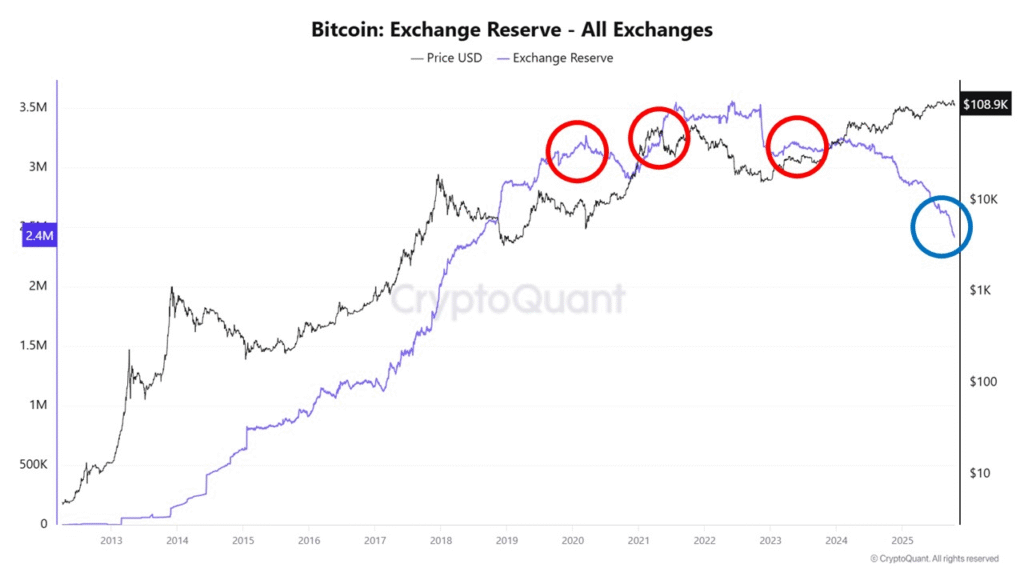
XWIN Research Japan observed that unless exchange balances climb again, the present phase resembles consolidation rather than capitulation. With supply constrained, Bitcoin’s market structure appears more mature—absorbing volatility without triggering widespread liquidations that previously defined downturns.
Long-Term Holders Maintain Confidence Through the Correction
Investor behavior offers another key difference between today’s market and prior cycles. During the 2020 and 2021 declines, long-term holders were quick to realize losses, reflected in the Long-Term Holder SOPR (LTH-SOPR) staying well below 1 for extended periods.
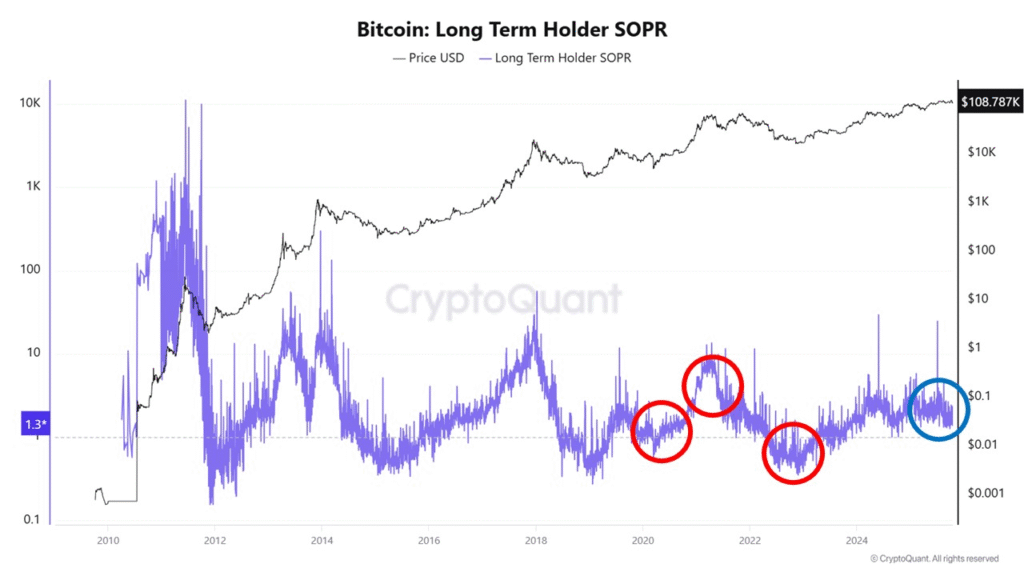
This time, the ratio remains close to neutral. That stability indicates measured profit-taking instead of broad capitulation.Long-term investors are comfortable staying in their positions, demonstrating a level of confidence assuring the market does not see a fall-off.
This kind of behavior does reinforce the underlying structure of the network. As these holders resist the temptation to panic sell, less selling pressure is created, liquidity stress does not increase. Such long-term steadiness can give Bitcoin the ability to weather short-term fluctuations and reinforces the idea that it is a maturing asset class in 2025.
Past Market Shocks Reveal Bitcoin’s Structural Evolution
Looking back at historical drawdowns allows us to better understand Bitcoin’s evolution. In March 2020, we experienced a crash that resulted in mass liquidations and large holders institutionally bought up Bitcoin, resulting in a V-shaped recovery. In May 2021, the Tesla withdrawal and China’s mining crackdown drove a 30% drop, with whales offloading about 50,000 BTC before repurchasing 34,000 BTC near the bottom.
A similar cleansing occurred in August 2023 after the U.S. debt downgrade triggered a brief 15% correction. Each event served to reset leverage levels and attract new accumulation from strong holders.
In contrast, the 2025 pullback is unfolding amid the lowest exchange reserves in a decade and steady long-term holder behavior. The combination of restricted supply and patient investors suggests this correction is more a structural reset than a panic phase. As liquidity remains tight and conviction deepens, the market appears positioned to transition naturally toward its next accumulation stage rather than repeat the extended declines of earlier cycles.
