




- Bitcoin’s short-term holders have returned to profit, showing improved market stability and renewed trader confidence after the recent corrective phase ended.
- Historical patterns reveal that each time spot traders regained profits, Bitcoin’s market resumed upward movement, supporting ongoing bullish structure recovery.
- Long-term holders continue reducing positions gradually, suggesting the bull cycle remains active with strong liquidity flow and sustained investor participation.
Spot traders have returned to profit, signaling renewed strength in Bitcoin’s ongoing bull trend. This recovery phase offers crucial insights into market behavior, especially as short-term holders regain footing after the recent correction.
Short-Term Holders Turn Profitable Again After a Testing Phase
Spot traders—those typically holding Bitcoin between one and three months—are now back in profit after several weeks of fluctuating prices. This group represents a reactive segment of the market, often referred to as on-chain traders, due to their sensitivity to volatility and quick decision-making.
As Darkfost observed, this category has re-entered the unrealized profit zone following a period of testing. Their realized price sits near $115,000, placing them in a modest gain of about 4%. Such limited profits suggest they are unlikely to sell aggressively at this stage, which helps maintain short-term price stability.
When short-term holders (STHs) remain patient during low-profit periods, it typically prevents abrupt selling pressure that could weaken market structure. The group’s behavior often serves as a reflection of broader sentiment, indicating whether optimism or caution dominates among recent market entrants.
Historical Behavior Points to End of Correction Phases
In previous market cycles, the same category of traders has provided useful reference points for identifying potential turning zones. Whenever their unrealized losses reached around -12%, the market often found a local bottom. During the latest correction, losses stayed near -5% before Bitcoin started recovering, suggesting a milder retracement phase compared to prior cycles.
This behavioral consistency implies that short-term holders are showing stronger conviction this time, supporting the idea that recent price dips might have concluded earlier than expected. With these traders now back in profit, the conditions appear more favorable for continued price growth.
Analysts note that each recovery phase where STHs regained profitability has historically aligned with the resumption of an upward trend. Monitoring their realized price levels offers a clearer view of near-term market resilience and helps assess whether renewed buying pressure is building within this group.
Long-Term Trends Indicate the Bull Cycle Is Still Intact
Complementing this short-term strength, Crypto Dan highlighted that Bitcoin’s broader bull market remains intact. In earlier cycles, the final stages of bullish phases were marked by a sharp decline in long-term held BTC—those retained for more than a year—as older coins were sold and liquidity surged.
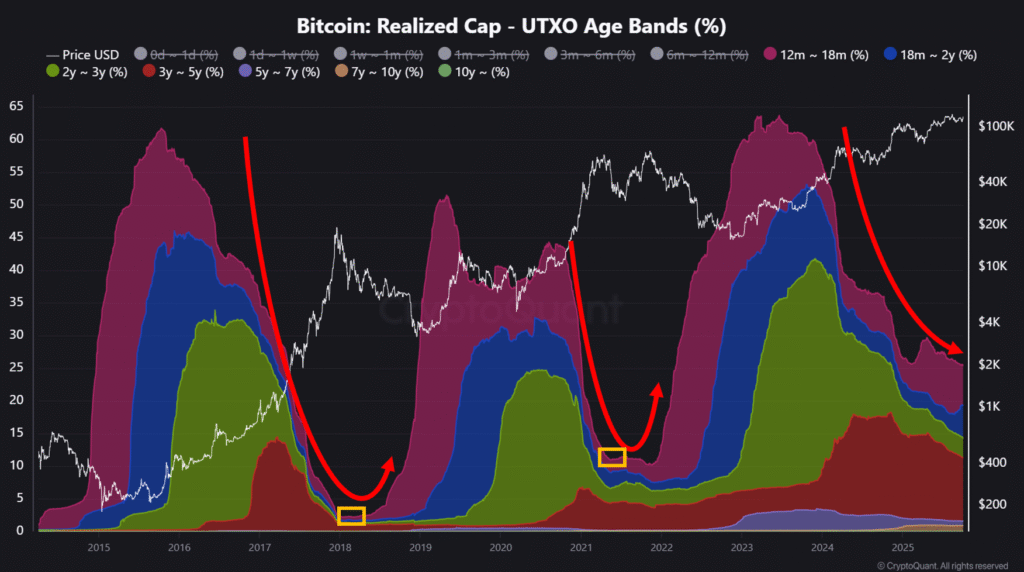
Source: Cryptoquant
At present, the share of long-term holdings is decreasing gradually rather than rapidly. This slow shift indicates that while some older coins are entering circulation, long-term investors are still confident in maintaining exposure. The gradual nature of this transition points to a maturing bull phase rather than a cycle nearing exhaustion.
Crypto Dan emphasized that the market’s progression remains steady and sustainable. The combination of patient short-term holders and stable long-term investors continues to support the broader bullish structure. With spot traders returning to profit and long-term holders maintaining conviction, Bitcoin’s bull trend appears to be building strength in a controlled and balanced manner.
